Documentation to "My Case"
Monday, February 13, 2006
Account of my persecution
-
1. When I was hired in a research faculty position by the Department of Earth and Space Sciences, SUNY at Stony Brook, on April 1, 1985, professors Robert C. Liebermann, Donald J. Weidner and Charles T. Prewitt had promised me that I would be treated as equal to other faculty members at the Department and that my position could or would become permanent. I also believed that this promise represented a firm commitment by the Department, in fact, a verbal contract.
2. For a while, everything was fine. The new multi-anvil (Sumitomo) press was installed in December 1985. Within a year after the testing was completed and I could start using the press, I developed the techniques, procedures and sample assemblies that made possible to conduct high-pressure multi-anvil experiments at a high success rate.
3. My first major study clearly demonstrating the successful operation of the Stony Brook High-Pressure Lab and the multi-anvil apparatus was published in 1989, and was followed in 1990 by four papers in the special volume of JGR published in memory of professor Chris Scarfe. These early developments and studies played a decisive role in the successful bid by the Mineral Physics Institute in Stony Brook to acquire, in 1990, a National Science Foundation (NSF) Science and Technology Center, the Center for High Pressure Research (CHiPR).
4. The problems, however, started soon after Prewitt accepted the position of the Director of the Geophysical Lab at the Carnegie Institution of Washington and left. Liebermann and Weidner stopped consulting with me about the lab and future plans and insisted on having complete control over everything, thus making it difficult for me to carry out my duties as the lab manager. Not having any or only minimal first-hand experience in high-pressure research, they tried to enforce procedures and rules that I knew from my experience were unworkable, and resulted in wasted effort, time and money. Despite their earlier promise to treat me as equal, and thus a partner, I have become a mere technician.
5. I believe now that they decided to get rid of me as soon as they had enough students and post-docs trained in the procedures and techniques that I had developed. To accomplish this goal, they initiated a series of incidents with the intention of making my life miserable and thus to force me to quit on my own.
6. In preparation for my future dismissal, they reshuffled the already sizable research staff funded by the CHiPR, placing all other scientists on state lines and leaving me alone on the research line to formally destroy my claim of seniority. They stonewalled my efforts to actively participate in the planning and developments, because they did not want me to play any role in the Center.
7. In the first documented incident, Liebermann invited professor David Walker from the Lamont-Doherty Laboratory to our lab at the beginning of 1988, ostensibly to do research with my help, despite the fact that professor Claude Herzberg from the Rutgers University warned us earlier that he was a bully. I believe now that this was done with the intention to create a conflict.
8. Following the visit, which to me appeared like a pleasant day filled with constructive discussion and friendly exchange of ideas, Walker sent a nasty letter to Liebermann accusing me of being unhelpful (E-1/1-1/2). Since the tone of the letter was so far out of proportion to what had actually happened, and all other outside users of the lab, for example professors Herzberg, Drake and Presnall, were highly satisfied with my help (e.g. E-2), this appeared to me as an attempt to bully me into working for him. When I refused to be bullied, he was forced to build his own multi-anvil lab, but kept looking for excuses to discredit me further.
9. Other nasty letters followed in 1988 (E-3) and 1990 (E-4). Walker also started trashing my reputation, as is evident from his otherwise positive review of one of our NSF proposals for the continued operation of the lab (E-5). He sent us a copy of this review, thus suggesting that a potential future review may not be as good if I were not taken care of. Finally, in December 1991, he accused Weidner and me of undermining the Ph.D. research of his student (E-6/1-6/2). In the following nasty letter from January 1992, he graciously forgave Weidner, but insisted that they “hang me out to dry” (E-7/1-7/2). This is corroborated by a supporting letter from professor Claude Herzberg, who has also been a victim of Walker’s bullying (E-8).
10. When it became apparent in January 1992 that the first incident failed in achieving the intended goal, that very month Liebermann permanently placed a secretary who smoked, Ann Lattimore, next to my office. In the previous 3 years, the secretary occupied on a temporary basis the same office, and I repeatedly complained to Liebermann about her smoking; thus he knew very well that second-hand smoke bothered me. I believe that this incident was again intended to make my life miserable and thus to force me to leave the employment on my own by exposing me to physically harmful working conditions (E-9/1-9/2-9/3-9/4-9/5-9/6-9/7). Not even my appeal to the Office of Human Resources would solve this problem (E-10/1-10/2-10/3). I ended up exposed to second-hand smoke for 5 years, until strict regulations forbidding smoking in the whole building forced the secretary to move to the first floor to be close to outdoors. However, the exchange of letters concerning this incident, and the possibility of a lawsuit resulting from it, probably saved me from being dismissed outright.
11. In addition to exposing me to mentally and physically harmful working conditions, Liebermann, with the help of other senior faculty members, professors, Weidner, Lindsley and Hanson, started attacking people who became closely associated with me or were particularly helpful to me in my work, with the intention to isolate me.
12. I had to make an extraordinary effort to save the job of one of the machinists, Herb Schay, who had been exceptionally helpful to me (E-11/1-11/2-11/3-11/4-11/5-11/6). Another equally helpful machinist, Ed Worisek, was forced into an early retirement. They scared Dr. Jianzhong Zhang from publishing a paper on the melting of brucite, a joined project with me, thus ending our collaboration. They refused to help a student that I attracted to the Department, Jozsef Garai, and then tried to terminate him from the graduate studies without my consent and under the excuse that he could not find an advisor. Another student, Vladimir Litvin, who came to Stony Brook to work with me, was forced to work with Lindsley.
13. As Liebermann and collaborating senior faculty members became more frustrated not being able to make me leave or even to slow me down in my research, they decided to take a different approach. Their opportunity came when professor Alexandra Navrotsky, one of the four CHiPR executives, was invited in 1997 to serve on the panel for the Petrology and Geochemistry Program of the NSF. I believe she misused her position of trust and her influence as the member of the Academy to convince the panel to reject the funding for three of my research proposals in a row. The interruption in the funding caused by her seriously affected my research in the most negative way. Only when I submitted the next proposal to the CSEDI Program, I was again able to obtain funds and to continue in my research. However, while my previous 3 NSF grants were all for 3 years, the CSEDI grant was only approved for 2 years, and its continuation was extended for only 1 year. I realized at this time that the participants in my persecution might have gained control over the research funding, and that the NSF itself may have become involved in my persecution.
14. Another series of incidents occurred in 1999, when it became evident that the Department would conduct a search for a faculty position. The purpose of these incidents was: (a) to make my life an work difficult again in the last desperate hope that I would quit on my own, (b) to sever my existing ties to the Department and prevent new ties, (c) to discourage me from applying for the upcoming faculty position, and (d) to make sure that even if I applied, the faculty members would not select me for the position.
15. On January 25, 1999, Liebermann sent an e-mail concerning a potential new student, Vladimir Litvin (E-12). Although, it was well known and understood that Litvin was coming to Stony Brook to work with me, Liebermann encouraged Lindsley and Nekvasil to consider him as their student under the excuse that he needed to become “intellectually flexible and open to learning new things.” He ended up working with Lindsley. I believe that the true reason for taking this student from me, without me having any say in this decision, was that Liebermann did not expect or want me to stay at the Department long enough to supervise Litvin until his graduation.
16. On February 10, 1999, Liebermann sent me a cryptic e-mail asking me to call a meeting of microprobe users that would exclude the microprobe specialist, Dr. Robert P. Rapp (E-13). At that time, I was temporarily his supervisor, because the previous supervisor, Lindsley, was on a sabbatical leave in Brussels. I took on this extra duty in the summer of 1998 with the understanding that this was just a formality, with nothing more than signing purchase orders. I believe that the Lieberman’s e-mail was meant to prepare grounds for a similar meeting called by Lindsley on October 19, 1999.
17. On February 19, 1999, a student that I had attracted to the Department, Jozsef Garai, gave a required departmental talk at the so-called Graduate Circus. The graduate committee decided to do, without my knowledge, something highly unusual: to invite to his talk an outside observer, professor Gene D. Sprouse, from the Department of Physics (E-14). I believe that this was a premeditated and unfriendly act against this student, intended to prepare grounds and justify the later attempt at his termination, which occurred in November 1999. I believe that the student became a target because he was closely associated with me.
18. On April 21, 1999, I was forced to write a memorandum to the Director of the Laboratories, James Broyles, to complain about the poor performance of the machine shop employees in manufacturing parts for high-pressure research (E-15/1, E-15/2). A second memorandum was written on July 22, 1999 (E-16), but the problem was not solved (E-17/1, E-17/2). I believe that this was a deliberate obstruction ordered by Liebermann and Weidner to impede my research and my work as the lab manager.
19. In the summer of 1999, professor John B. Parise dismissed me as a volunteered supervisor of a summer scholar, after a major investment by me in time and effort, under the excuse that the student had complained. This ended my participation in the program after several years of highly successful work with summer students, which produced a number of important publications and discoveries.
20. On August 31, 1999, Lindsley, after his return from the sabbatical leave in Belgium, made the first attempt to call a meeting of microprobe users (E-18). I did not attend the meeting, which apparently took place on September 3, 1999, because I was not comfortable with the decision to exclude the microprobe specialist, Dr. Rapp, from the meeting.
21. I suspect that my absence at the meeting on September 3, 1999, was the cause that the meeting did not to fulfill its intended purpose, and Lindsley called the same meeting again for October 19, 1999 (E-19). This time, he also sent a separate e-mail invitation for me (E-20). To assure my participation, Liebermann visited me in the high-pressure lab and used his utmost charm to convince me to attend, although I hesitated to do so again because of the exclusion of Dr. Rapp. However, before I attended the meeting, I notified Dr. Rapp that this meeting was taking place and that he was not invited.
22. At the meeting on October 19, 1999, I was provoked by Lindsley into an ugly confrontation by being accused of mismanaging the probe. I believe now that Dr. Rapp was excluded so he would not come to my defense, and that the true purpose of the meeting was to turn the faculty members against me, so that they would not vote for me if I applied for the upcoming faculty position.
23. Soon after Lindsley regained the control of the microprobe lab on October 19, 1999, the microprobe started breaking down and was out of use repeatedly over time intervals of up to 6 months. I believe that this was done on purpose to impede my research and generate the impression that the microprobe was reaching the end of its useful life. However, when it became evident, after April 2001, that I was no longer doing research, the microprobe miraculously recovered and has been in continuous use without any serious problems ever since.
24. On November 11, 1999, I was notified that the graduate committee decided, without any prior consultation with me, to terminate the student that I had attracted to the Department and was closely associated with, Jozsef Garai, under the excuse that the student has “not succeeded in identifying a viable research project and a faculty advisor willing to supervise this project” (E-21). This forced me to become his advisor, although he was far better qualified to do a project in geophysics rather than in geochemistry, and the student later successfully completed his studies at the Stony Brook University under my supervision with a M.S. degree.
25. In December 1999, the multi-anvil press developed technical problems that required a major repair, and the press was out of use for 9 months (E-22). In the context and in the view of the inferred purposes for the other incidents of 1999, and perhaps in retaliation for saving Jozsef Garai, I believe now that the press was intentionally sabotaged to stop me from continuing in my research and to burden me with the task of fixing the press.
26. At the end of 1999, the two most important facilities essential for me to conduct research, the multi-anvil press and the electron microprobe, were temporarily disabled, and I was demoralized by a long series of hard-to-explain incidents initiated by my colleagues and self-professed “friends.” Ironically, the year 1999 was also my most productive year, resulting in 10 published articles in 2000.
27. On February 17, 2000, I received e-mail from Weidner asking me to meet him and Liebermann to “discuss the future of CHiPR” (E-23). At the meeting on February 19, 2000, they informed me that they were asking all members of the CHiPR research staff to look for other employment opportunities in view of the expected end of the CHiPR after 11 years, and in view of the uncertain outlook as to its possible continuation in other form. Weidner also discouraged me from applying for a new faculty position, in reference to the ongoing search, with the words: “You can apply, but they don’t want you,” meaning under “they” the faculty members of the Department. At that time I still believed, because of my seniority and promise of a permanent position made by the time of my hiring on April 1, 1985, that I would be dismissed only under the worst circumstances, and along with all other CHiPR scientists. Instead, it turned out that I would be the only one dismissed.
28. The multi-anvil press became functional again in August 2000 (E-24) and, despite the constant shortage of assembly parts and frequent breakdowns of the microprobe, I was still able to continue with increasing difficulty to conduct research. I finally gave up on research in April 2001, and started working on my book: “Phase Diagrams for Geoscientists.”
29. On August 27, 2001, I appealed to the faculty members at the Department to honor the commitment to the permanent position that they had made to me when I was hired 17 years earlier (E-25). In the reply from September 10, 2001, the Chair, Scott M. McLennen, informed me that the Department would not keep the promise, and instead he placed the blame on me because I “chose not to apply” for the last faculty position (E-26). This was a dishonest answer, in view of all the discouragements resulting from the incidents of 1999, which he must have been well aware of, and the fact that not a single faculty member encouraged me to apply, while it was still possible. Shortly after, on September 14, 2001, I received a notice of termination signed by Weidner and Liebermann (E-27).
30. On January 31, 2002, the CHiPR ended its planned 11 years of operation, and I was dismissed, in gross violation of my true seniority status, and under the excuse that the project had ended (E-28). It has since become evident that I was the only scientist dismissed under this excuse, despite being the most productive and accomplished member of the CHiPR research staff (E-29/1-29/2).
31. The CHiPR was resurrected as the Consortium for Materials Properties Research in Earth Sciences (COMPRES) initiative, funded by the same resources that were used previously to fund CHiPR. Aside from the cosmetic changes in its structure, to cover up the fact that COMPRES is CHiPR under a new name, the only practical difference is that my paid position of lab manager was formally eliminated, and my former paycheck is now used to fund the administrative position of the president of COMPRES. Although this position is advertised as open to everybody, a pattern now emerges to suggest that this position is meant to rotate among the executive members as the reward for supporting the COMPRES initiative, and my former paycheck is being used to supplement their salaries. The current president of COMPRES, Liebermann, was hired to this position by a search committee headed by David Walker.
32. While it was always evident to me that the Department was not interested in retaining me, regardless of my accomplishments and contributions to the reputation of the Department and to the advancement of science, I still hoped that I should not experience any major difficulties finding a faculty position elsewhere, and that my colleagues at the Department, while desperately trying to get rid of me, might even be helpful in that respect.
33. Since November 2001, I have been applying for advertised employment opportunities at other universities and colleges, but without any success (E-30/1-30/2-30/3-30/4). Even the promise of publishing a landmark book under the affiliation of a potential future employer and, after it was published in March 2003, the fact of this additional major contribution to the advancement of science, did not have any effect. This led me to conclude that the participants in my persecution at the Department were not only trying to get rid of me, but engaged in a campaign of lies to further trash my reputation and thus to destroy my scientific career completely.
34. At the beginning of September 2002, after Liebermann left and started his sabbatical leave in France, I found the following sign on the door of his office: “AGE AND TREACHERY ALWAYS OVERCOME YOUTH AND SKILLS” (E-31). This immediately struck me as some kind of crude declaration of victory by Liebermann addressed to me. Since everyone else seeing the sign might have suspected that I put up the sign myself to embarrass him, I took it down.
35. As soon as the work on my book was completed by the end of 2002, I started to search for the explanation or explanations for the startling discrepancy between my performance and accomplishments as a scientist, and the indifferent to hostile behavior by my colleagues at the Department of Geosciences and by the scientific community. It was becoming evident that a number of people devoted extraordinary amounts of time and effort to a single goal: to push me out of research and education.
36. Since I had remained in my unpaid academic position of Research Associate Professor, I tried to raise income by applying for research grants. My first attempt to secure a research grant from the NSF, made at the end of 2002, was unsuccessful (E-32). Since my paid position was eliminated in consultation with the staff of the NSF, as specified by Liebermann and Weidner in their notice of termination of my employment from September 14, 2001 (E-27), I used this opportunity to investigate if the NSF played a role in my persecution.
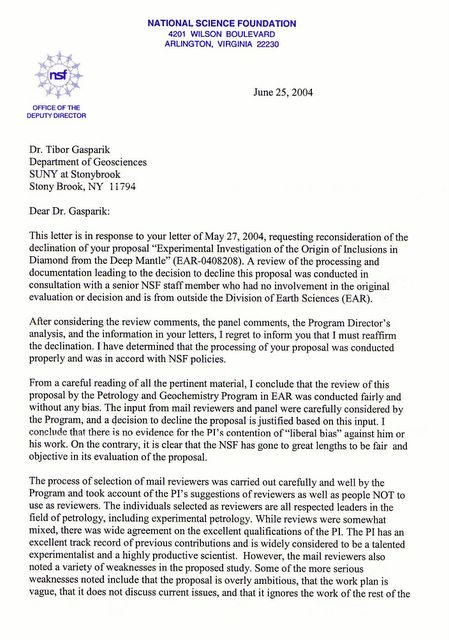
37. Of the 5 reviews of my proposal, 3 were rated excellent or very good, and are among the best reviews I have ever received. The other 2 that rated me “fair” were obviously responsible for the declination of funding (E-33). The results were as unambiguous as they can get in confirming that the NSF may have selected these two reviewers to assure that my proposal would not receive funding. I am fairly confident that these two reviewers were Alexandra Navrotsky and David Walker. When I subsequently challenged the fairness of the review process using the standard appeal process, I was stonewalled at every step all the way to the NSF director, Dr. Rita R. Calwell, apparently to cover up the corruption of the review process and the participation of the NSF in my persecution (E-34/1-34/2-34/3-34/4-34/5-34/6-34/7-34/8).
38. It had also become evident to me, by the time I finished the appeals, that the NSF stopped sending me proposals for review since the termination of my employment in January 2002 (E-35). While I received 5 proposals to review in 2001, none were sent in 2002 and 2003. It appeared that the Program Directors have simply written me off, and thus must have known that my career was over well ahead of me.
39. Before I started investigating the potential role of the SUNY administrators in my persecution, I appealed one more time to Liebermann and Weidner for help (E-36). While Weidner did not reply, I met in person with Liebermann right after his return from the sabbatical leave in France in August 2003. However, this meeting did not produce any useful results despite the fact that Liebermann announced to me that he was starting as the new president of COMPRES and thus was evidently in a prime position to help.
40. In August 2003, I also identified for the first time the methods used in my persecution, known as “mobbing.” The Web site: http://www.leymann.se/, defines mobbing as a form of bullying in the workplace, when several coworkers gang up on a person to force him or her to quit, and represents a violation of the civil rights of that person (E-37). These mobbing activities are usually very subtle; a series of hard-to-explain, sometimes bizarre events, which each by itself could easily be dismissed as the product of a paranoid mind. Only in retrospect, as the severe consequences of the mobbing process become apparent, these events start making sense. In my case, it took 15 years for the bullying process to play out, and for me to fully understand the true nature of these attacks. The severe consequences for me are the inability to conduct research since April 2001, isolation from the scientific community, mental anguish (PTSD), and so far the loss of $300,000 in personal income.
41. I described my persecution as “mobbing” in my letter to the Provost of the Stony Brook University, Dr. Robert L. McGrath, dated September 8, 2003, and asked him to intervene in this matter (E-38). After he refused (E-39), I appealed on September 22, 2003, to the President of the Stony Brook University, Dr. Shirley Strum Kenny, and asked her to initiate disciplinary hearings against the 4 senior faculty members at the Department of Geosciences, professors Liebermann, Weidner, Lindsley and Hanson (E-40). The President forwarded my appeal to the Director of Human Resource Services, Lynn M. Johnson (E-41), which in turn denied the appeal (E-42). It had become evident to me that the administrators of the Stony Brook University would not intervene on my behalf regardless of the merit of my complaint, and that they may have also been participants in my persecution.
42. On October 6, 2003, I asked Lindsley to serve as a mediator to help addressing what I already believed was a violation of my civil rights, and to find a solution to the conflict (E-43). In his reply from October 27, 2003 (E-44/1-44/2), Lindsley refused to serve as a mediator, but admitted that I had a valid reason to believe that the Department made a commitment to my permanent employment, discouraged me from filing a lawsuit, and confirmed that the Department had no interest in retaining me despite my contributions to the Department and “impressive research at high-pressures.”
43. On November 10, 2003, I finally confronted what I already believed was the mastermind in my persecution, Liebermann, with all the evidence that I had discovered, including the correspondence with the NSF, and asked him to come to his senses, stop persecuting me and agree to undo the damage that he had caused (E-45). In his reply from November 14, 2003, he wrote: “I acknowledge receipt of your letter from November 10, 2003, and the associated materials” (E-46). When I met him personally on November 24, 2003, and asked him to reconsider his reply, he kept only repeating: “I have nothing else to say.”
44. On November 28, 2003, I wrote to Weidner and asked him again for help (E-47). In his reply from January 2, 2004, he refused (E-48).
45. On January 8, 2004, I wrote to the Chair of the Department, Scott McLennan, and appealed through him to all faculty members for help (E-49). He stopped by in my office to tell me that since January 1, 2004, he was no longer the Chair, and if he could forward the letter to the new Chair, professor Teng-fong Wong. I agreed. However, this letter and the following letter sent to Teng-fong Wong on April 13, 2004 (E-50), have remained unanswered by him or any other faculty member.
46. Since the fall of 2003, I have become increasingly aware, mainly on the basis of the information available on the Internet, that liberal professors vastly outnumber conservative professors at the universities and colleges in the United States, and that this could be the result of discrimination against conservative professors in hiring and promotion (e.g. E-51). I have never tried to hide neither my conservative views nor my record of voting for Republican candidates, and realized that I could not name a faculty member at the Department or any other university professor who was not a liberal. Hence, in April 2004, still unable to explain the sharp contrast between my superior accomplishments as a scientist and the indifference to my plight and stonewalling that I had received from the officials at the National Science Foundation, administrators at the Stony Brook University, and faculty members at the Department of Geosciences, I finally realized that my political orientation and, since July 2002, affiliation as a registered member of the Republican party, may have played a much more important role in my persecution than I had been ready to accept before. I also realized that the fact of being a refugee from communism, which is widely known in the scientific community, may have been used as a flag to identify me as a likely conservative in my numerous attempts to find employment at other universities and colleges, and thus could explain my inability to find employment elsewhere.
47. Unable to receive any response from the Chair of the Department, Teng-fong Wong, I appealed on April 20, 2004, to the President of the Stony Brook University, Dr. Shirley Strum Kenny, the decision from October 22, 2003, by the Director of Human Resource Services, Lynn M. Johnson, not to initiate disciplinary hearings against the four senior faculty members at the Department of Geosciences (E-52). For the first time I addressed what I believe now is the true reason for my persecution: my political orientation. I renewed my request for disciplinary hearings and asked that at least 50% of the commission members in charge of the disciplinary hearings should be registered Republicans. My appeal was denied on May 19, 2004 (E-53).
48. The funding for my National Science Foundation proposal resubmitted by the December 1, 2003, deadline was denied again in April 2004 (E-54/1, E-54/2). This time I appealed directly to the new NSF Director, Dr. Arden L. Bement, on May 5, 2004 (E-55), and again on December 27, 2004 (E-56). With the appeals, I also presented my case and all relevant documentation. The appeals were again unsuccessful, and my case was ignored (E-57/1-57/2-57/3-57/4).
49. Since all my attempts to convince the parties to stop persecuting me failed, I was forced to make the account of my persecution public by posting it, at the end of June 2005, on the Web site: http://suny-stonybrook.blogspot.com/. To bring attention to the Web site, I sent e-mails to all participants in my persecution and to other persons knowledgeable about my case at the Department of Geosciences, Stony Brook University, National Science Foundation, as well as to the Science Advisor to the President, conservative members of the Senate, and the President of the United States (E-58). With this I believe that I have done my duty, as a concerned scientist and a citizen of the United States, to bring the issue of discrimination in the Academia based on political orientation, as reflected in my experience, to all authorities outside of the judicial system that have the power and duty to address this issue.
50. In retaliation for posting the Web site and in violation of my First Amendment rights, my name was taken off the list of faculty members posted on the departmental Web site, my mailbox was removed, and I was ordered to vacate my office (E-59). Because this latest hostile action by the Department and the University makes it extremely difficult or nearly impossible for me to continue in my efforts to secure research funding, restart my career as scientist and professor, and further contribute to the advancement of science, I was forced to seek justice through the legal system, and filed a complaint at the United States District Court in Central Islip on August 11, 2005 (E-60).
References
E-1/1-2 Letter from Dave Walker to Bob Liebermann, 3/16/1988.
E-2 Letter from Mike Drake to Tibor Gasparik, 7/7/1987.
E-3 Letter from Dave Walker to Bob Liebermann, 4/1/1988.
E-4 Letter from Dave Walker to Bob Liebermann, 2/13/1990.
E-5 Review of a NSF proposal by Dave Walker, 9/18/1989.
E-6/1-2 Letter from Dave Walker to Weidner and Liebermann, 12/17/1991.
E-7/1-2 Letter from Dave Walker to Weidner and Liebermann, 1/7/1992.
E-8 Letter from Claude Herzberg to Don Weidner, 1/9/1992.
E-9/1-2-3 Letter from Tibor Gasparik to Bob Liebermann, 1/21/1992.
E-9/4-5 Letter from Bob Liebermann to Tibor Gasparik, 2/3/1992.
E-9/6 Letter from Tibor Gasparik to Bob Liebermann, 2/4/1992.
E-9/7 Letter from Bob Liebermann to Tibor Gasparik, 2/4/1992.
E-10/1-2-3 Letter from Tibor Gasparik to Karen Nimmons, 3/4/1992.
E-11/1-2-3 Letter from Tibor Gasparik to Gil Hanson, 2/13/1992.
E-11/4 Letter from Don Lindsley to Tibor Gasparik, 2/23/1992.
E-11/5 Letter from Gil Hanson to Tibor Gasparik, 10/26/1992.
E-11/6 Letter from Tibor Gasparik to Gil Hanson, 11/18/1992.
E-12 E-mail from Bob Liebermann to John Parise, 1/25/1999.
E-13 E-mail from Bob Liebermann to Tibor Gasparik, 2/10/1999.
E-14 E-mail from John Parise, 2/22/1999.
E-15/1 Letter from Tibor Gasparik to Jim Broyles, 4/21/1999.
E-15/2 Letter from Jim Broyles to Tibor Gasparik, 4/22/1999.
E-16 Letter from Tibor Gasparik to Jim Broyles, 6/22/1999.
E-17/1-2 Letter from Jim Broyles to Tibor Gasparik, 6/25/1999.
E-18 E-mail from Don Lindsley to probe users, 8/31/1999.
E-19 E-mail from Don Lindsley to probe users, 10/15/1999.
E-20 E-mail from Don Lindsley to Tibor Gasparik, 10/15/1999.
E-21 E-mail from John Parise, 11/11/1999.
E-22 E-mails between Tibor Gasparik and Gabriel Gwanmesia, 12/6,13/1999.
E-23 E-mail from Don Weidner to Tibor Gasparik, 2/17/2000.
E-24 E-mail from Don Weidner to Tibor Gasparik, 8/30/2000.
E-25 Letter from Tibor Gasparik to faculty members, 8/27/2001.
E-26 Letter from Scott McLennan to Tibor Gasparik, 9/10/2001.
E-27 Letter from Weidner and Liebermann to Tibor Gasparik, 9/14/2001.
E-28 Notice of dismissal, 1/31/2002.
E-29/1-2 Ratings of CHiPR participants and faculty members (1989-2001).
E-30/1-2-3-4 Work Search Record, 11/27/2001 to 5/20/2002.
E-31 Sign “AGE AND TREACHERY ALWAYS OVERCOME YOUTH AND SKILLS”
E-32 E-mail from Herman Zimmerman to Tibor Gasparik, 4/14/2003.
E-33 Panel summary and reviews, April 2003.
E-34/1 Letter from Tibor Gasparik to Herman Zimmerman, 4/10/2003.
E-34/2 E-mail from Herman Zimmerman to Tibor Gasparik, 4/15/2003.
E-34/3 Letter from Tibor Gasparik to Margaret Leinen, 4/21/2003.
E-34/4 Letter from Margaret Leinen to Tibor Gasparik, 5/15/2003.
E-34/5 Letter from Tibor Gasparik to Joseph Bordogna, 5/21/2003.
E-34/6 Letter from Joseph Bordogna to Tibor Gasparik, 7/3/2003.
E-34/7 Letter from Tibor Gasparik to Rita Colwell, 6/26/2003.
E-34/8 Letter from Margaret Cavanaugh to Tibor Gasparik, 7/28/2003.
E-35 Reviews of the NSF proposals, 1985-2005.
E-36 Letter from Tibor Gasparik to Don Weidner, 7/15/2003.
E-37 The Mobbing Encyclopaedia.
E-38 Letter from Tibor Gasparik to Robert McGrath, 9/8/2003.
E-39 Letter from Robert McGrath to Tibor Gasparik, 9/16/2003.
E-40 Letter from Tibor Gasparik to Shirley Strum Kenny, 9/22/2003.
E-41 Letter from Shirley Strum Kenny to Tibor Gasparik, 10/2/2003.
E-42 Letter from Lynn Johnson to Tibor Gasparik, 10/22/2003.
E-43 Letter from Tibor Gasparik to Don Lindsley, 10/6/2003.
E-44/1-2 Letter from Don Lindsley to Tibor Gasparik, 10/27/2003.
E-45 Letter from Tibor Gasparik to Bob Liebermann, 11/10/2003.
E-46 Letter from Bob Liebermann to Tibor Gasparik, 11/14/2003.
E-47 Letter from Tibor Gasparik to Don Weidner, 11/28/2003.
E-48 Letter from Don Weidner to Tibor Gasparik, 1/2/2004.
E-49 Letter from Tibor Gasparik to Scott McLennan, 1/8/2004.
E-50 Letter from Tibor Gasparik to Teng-fong Wong, 4/13/2004.
E-51 Article by David Horowitz: “The Campus Blacklist,” 4/18/2003.
E-52 Letter from Tibor Gasparik to Shirley Strum Kenny, 4/20/2004.
E-53 Letter from Shirley Strum Kenny to Tibor Gasparik, 5/19/2004.
E-54/1 E-mail from Herman Zimmerman to Tibor Gasparik, 4/11/2004.
E-54/2 Panel summary and reviews, April 2004.
E-55 Letter from Tibor Gasparik to Arden Bement, 5/5/2004.
E-56 Letter from Tibor Gasparik to Arden Bement, 12/27/2004.
E-57/1 Letter from John Hunt to Tibor Gasparik, 5/18/2004.
E-57/2 Letter from Tibor Gasparik to Margaret Leinen, 5/27/2004.
E-57/3-4 Letter from Margaret Leinen to Tibor Gasparik, 6/25/2004.
E-58 E-mails from Tibor Gasparik to various officials, 6/27/2005 to 7/16/2005.
E-59 E-mail from Tibor Gasparik to Teng-fong Wong, 7/13/2005.
E-60 E-mails between Tibor Gasparik to Teng-fong Wong, 8/10,12/2005.
1. When I was hired in a research faculty position by the Department of Earth and Space Sciences, SUNY at Stony Brook, on April 1, 1985, professors Robert C. Liebermann, Donald J. Weidner and Charles T. Prewitt had promised me that I would be treated as equal to other faculty members at the Department and that my position could or would become permanent. I also believed that this promise represented a firm commitment by the Department, in fact, a verbal contract.
2. For a while, everything was fine. The new multi-anvil (Sumitomo) press was installed in December 1985. Within a year after the testing was completed and I could start using the press, I developed the techniques, procedures and sample assemblies that made possible to conduct high-pressure multi-anvil experiments at a high success rate.
3. My first major study clearly demonstrating the successful operation of the Stony Brook High-Pressure Lab and the multi-anvil apparatus was published in 1989, and was followed in 1990 by four papers in the special volume of JGR published in memory of professor Chris Scarfe. These early developments and studies played a decisive role in the successful bid by the Mineral Physics Institute in Stony Brook to acquire, in 1990, a National Science Foundation (NSF) Science and Technology Center, the Center for High Pressure Research (CHiPR).
4. The problems, however, started soon after Prewitt accepted the position of the Director of the Geophysical Lab at the Carnegie Institution of Washington and left. Liebermann and Weidner stopped consulting with me about the lab and future plans and insisted on having complete control over everything, thus making it difficult for me to carry out my duties as the lab manager. Not having any or only minimal first-hand experience in high-pressure research, they tried to enforce procedures and rules that I knew from my experience were unworkable, and resulted in wasted effort, time and money. Despite their earlier promise to treat me as equal, and thus a partner, I have become a mere technician.
5. I believe now that they decided to get rid of me as soon as they had enough students and post-docs trained in the procedures and techniques that I had developed. To accomplish this goal, they initiated a series of incidents with the intention of making my life miserable and thus to force me to quit on my own.
6. In preparation for my future dismissal, they reshuffled the already sizable research staff funded by the CHiPR, placing all other scientists on state lines and leaving me alone on the research line to formally destroy my claim of seniority. They stonewalled my efforts to actively participate in the planning and developments, because they did not want me to play any role in the Center.
7. In the first documented incident, Liebermann invited professor David Walker from the Lamont-Doherty Laboratory to our lab at the beginning of 1988, ostensibly to do research with my help, despite the fact that professor Claude Herzberg from the Rutgers University warned us earlier that he was a bully. I believe now that this was done with the intention to create a conflict.
8. Following the visit, which to me appeared like a pleasant day filled with constructive discussion and friendly exchange of ideas, Walker sent a nasty letter to Liebermann accusing me of being unhelpful (E-1/1-1/2). Since the tone of the letter was so far out of proportion to what had actually happened, and all other outside users of the lab, for example professors Herzberg, Drake and Presnall, were highly satisfied with my help (e.g. E-2), this appeared to me as an attempt to bully me into working for him. When I refused to be bullied, he was forced to build his own multi-anvil lab, but kept looking for excuses to discredit me further.


9. Other nasty letters followed in 1988 (E-3) and 1990 (E-4). Walker also started trashing my reputation, as is evident from his otherwise positive review of one of our NSF proposals for the continued operation of the lab (E-5). He sent us a copy of this review, thus suggesting that a potential future review may not be as good if I were not taken care of. Finally, in December 1991, he accused Weidner and me of undermining the Ph.D. research of his student (E-6/1-6/2). In the following nasty letter from January 1992, he graciously forgave Weidner, but insisted that they “hang me out to dry” (E-7/1-7/2). This is corroborated by a supporting letter from professor Claude Herzberg, who has also been a victim of Walker’s bullying (E-8).


10. When it became apparent in January 1992 that the first incident failed in achieving the intended goal, that very month Liebermann permanently placed a secretary who smoked, Ann Lattimore, next to my office. In the previous 3 years, the secretary occupied on a temporary basis the same office, and I repeatedly complained to Liebermann about her smoking; thus he knew very well that second-hand smoke bothered me. I believe that this incident was again intended to make my life miserable and thus to force me to leave the employment on my own by exposing me to physically harmful working conditions (E-9/1-9/2-9/3-9/4-9/5-9/6-9/7). Not even my appeal to the Office of Human Resources would solve this problem (E-10/1-10/2-10/3). I ended up exposed to second-hand smoke for 5 years, until strict regulations forbidding smoking in the whole building forced the secretary to move to the first floor to be close to outdoors. However, the exchange of letters concerning this incident, and the possibility of a lawsuit resulting from it, probably saved me from being dismissed outright.


11. In addition to exposing me to mentally and physically harmful working conditions, Liebermann, with the help of other senior faculty members, professors, Weidner, Lindsley and Hanson, started attacking people who became closely associated with me or were particularly helpful to me in my work, with the intention to isolate me.
12. I had to make an extraordinary effort to save the job of one of the machinists, Herb Schay, who had been exceptionally helpful to me (E-11/1-11/2-11/3-11/4-11/5-11/6). Another equally helpful machinist, Ed Worisek, was forced into an early retirement. They scared Dr. Jianzhong Zhang from publishing a paper on the melting of brucite, a joined project with me, thus ending our collaboration. They refused to help a student that I attracted to the Department, Jozsef Garai, and then tried to terminate him from the graduate studies without my consent and under the excuse that he could not find an advisor. Another student, Vladimir Litvin, who came to Stony Brook to work with me, was forced to work with Lindsley.


13. As Liebermann and collaborating senior faculty members became more frustrated not being able to make me leave or even to slow me down in my research, they decided to take a different approach. Their opportunity came when professor Alexandra Navrotsky, one of the four CHiPR executives, was invited in 1997 to serve on the panel for the Petrology and Geochemistry Program of the NSF. I believe she misused her position of trust and her influence as the member of the Academy to convince the panel to reject the funding for three of my research proposals in a row. The interruption in the funding caused by her seriously affected my research in the most negative way. Only when I submitted the next proposal to the CSEDI Program, I was again able to obtain funds and to continue in my research. However, while my previous 3 NSF grants were all for 3 years, the CSEDI grant was only approved for 2 years, and its continuation was extended for only 1 year. I realized at this time that the participants in my persecution might have gained control over the research funding, and that the NSF itself may have become involved in my persecution.
14. Another series of incidents occurred in 1999, when it became evident that the Department would conduct a search for a faculty position. The purpose of these incidents was: (a) to make my life an work difficult again in the last desperate hope that I would quit on my own, (b) to sever my existing ties to the Department and prevent new ties, (c) to discourage me from applying for the upcoming faculty position, and (d) to make sure that even if I applied, the faculty members would not select me for the position.
15. On January 25, 1999, Liebermann sent an e-mail concerning a potential new student, Vladimir Litvin (E-12). Although, it was well known and understood that Litvin was coming to Stony Brook to work with me, Liebermann encouraged Lindsley and Nekvasil to consider him as their student under the excuse that he needed to become “intellectually flexible and open to learning new things.” He ended up working with Lindsley. I believe that the true reason for taking this student from me, without me having any say in this decision, was that Liebermann did not expect or want me to stay at the Department long enough to supervise Litvin until his graduation.
16. On February 10, 1999, Liebermann sent me a cryptic e-mail asking me to call a meeting of microprobe users that would exclude the microprobe specialist, Dr. Robert P. Rapp (E-13). At that time, I was temporarily his supervisor, because the previous supervisor, Lindsley, was on a sabbatical leave in Brussels. I took on this extra duty in the summer of 1998 with the understanding that this was just a formality, with nothing more than signing purchase orders. I believe that the Lieberman’s e-mail was meant to prepare grounds for a similar meeting called by Lindsley on October 19, 1999.
17. On February 19, 1999, a student that I had attracted to the Department, Jozsef Garai, gave a required departmental talk at the so-called Graduate Circus. The graduate committee decided to do, without my knowledge, something highly unusual: to invite to his talk an outside observer, professor Gene D. Sprouse, from the Department of Physics (E-14). I believe that this was a premeditated and unfriendly act against this student, intended to prepare grounds and justify the later attempt at his termination, which occurred in November 1999. I believe that the student became a target because he was closely associated with me.
18. On April 21, 1999, I was forced to write a memorandum to the Director of the Laboratories, James Broyles, to complain about the poor performance of the machine shop employees in manufacturing parts for high-pressure research (E-15/1, E-15/2). A second memorandum was written on July 22, 1999 (E-16), but the problem was not solved (E-17/1, E-17/2). I believe that this was a deliberate obstruction ordered by Liebermann and Weidner to impede my research and my work as the lab manager.


19. In the summer of 1999, professor John B. Parise dismissed me as a volunteered supervisor of a summer scholar, after a major investment by me in time and effort, under the excuse that the student had complained. This ended my participation in the program after several years of highly successful work with summer students, which produced a number of important publications and discoveries.
20. On August 31, 1999, Lindsley, after his return from the sabbatical leave in Belgium, made the first attempt to call a meeting of microprobe users (E-18). I did not attend the meeting, which apparently took place on September 3, 1999, because I was not comfortable with the decision to exclude the microprobe specialist, Dr. Rapp, from the meeting.
21. I suspect that my absence at the meeting on September 3, 1999, was the cause that the meeting did not to fulfill its intended purpose, and Lindsley called the same meeting again for October 19, 1999 (E-19). This time, he also sent a separate e-mail invitation for me (E-20). To assure my participation, Liebermann visited me in the high-pressure lab and used his utmost charm to convince me to attend, although I hesitated to do so again because of the exclusion of Dr. Rapp. However, before I attended the meeting, I notified Dr. Rapp that this meeting was taking place and that he was not invited.
22. At the meeting on October 19, 1999, I was provoked by Lindsley into an ugly confrontation by being accused of mismanaging the probe. I believe now that Dr. Rapp was excluded so he would not come to my defense, and that the true purpose of the meeting was to turn the faculty members against me, so that they would not vote for me if I applied for the upcoming faculty position.
23. Soon after Lindsley regained the control of the microprobe lab on October 19, 1999, the microprobe started breaking down and was out of use repeatedly over time intervals of up to 6 months. I believe that this was done on purpose to impede my research and generate the impression that the microprobe was reaching the end of its useful life. However, when it became evident, after April 2001, that I was no longer doing research, the microprobe miraculously recovered and has been in continuous use without any serious problems ever since.
24. On November 11, 1999, I was notified that the graduate committee decided, without any prior consultation with me, to terminate the student that I had attracted to the Department and was closely associated with, Jozsef Garai, under the excuse that the student has “not succeeded in identifying a viable research project and a faculty advisor willing to supervise this project” (E-21). This forced me to become his advisor, although he was far better qualified to do a project in geophysics rather than in geochemistry, and the student later successfully completed his studies at the Stony Brook University under my supervision with a M.S. degree.
25. In December 1999, the multi-anvil press developed technical problems that required a major repair, and the press was out of use for 9 months (E-22). In the context and in the view of the inferred purposes for the other incidents of 1999, and perhaps in retaliation for saving Jozsef Garai, I believe now that the press was intentionally sabotaged to stop me from continuing in my research and to burden me with the task of fixing the press.
26. At the end of 1999, the two most important facilities essential for me to conduct research, the multi-anvil press and the electron microprobe, were temporarily disabled, and I was demoralized by a long series of hard-to-explain incidents initiated by my colleagues and self-professed “friends.” Ironically, the year 1999 was also my most productive year, resulting in 10 published articles in 2000.
27. On February 17, 2000, I received e-mail from Weidner asking me to meet him and Liebermann to “discuss the future of CHiPR” (E-23). At the meeting on February 19, 2000, they informed me that they were asking all members of the CHiPR research staff to look for other employment opportunities in view of the expected end of the CHiPR after 11 years, and in view of the uncertain outlook as to its possible continuation in other form. Weidner also discouraged me from applying for a new faculty position, in reference to the ongoing search, with the words: “You can apply, but they don’t want you,” meaning under “they” the faculty members of the Department. At that time I still believed, because of my seniority and promise of a permanent position made by the time of my hiring on April 1, 1985, that I would be dismissed only under the worst circumstances, and along with all other CHiPR scientists. Instead, it turned out that I would be the only one dismissed.
28. The multi-anvil press became functional again in August 2000 (E-24) and, despite the constant shortage of assembly parts and frequent breakdowns of the microprobe, I was still able to continue with increasing difficulty to conduct research. I finally gave up on research in April 2001, and started working on my book: “Phase Diagrams for Geoscientists.”
29. On August 27, 2001, I appealed to the faculty members at the Department to honor the commitment to the permanent position that they had made to me when I was hired 17 years earlier (E-25). In the reply from September 10, 2001, the Chair, Scott M. McLennen, informed me that the Department would not keep the promise, and instead he placed the blame on me because I “chose not to apply” for the last faculty position (E-26). This was a dishonest answer, in view of all the discouragements resulting from the incidents of 1999, which he must have been well aware of, and the fact that not a single faculty member encouraged me to apply, while it was still possible. Shortly after, on September 14, 2001, I received a notice of termination signed by Weidner and Liebermann (E-27).


30. On January 31, 2002, the CHiPR ended its planned 11 years of operation, and I was dismissed, in gross violation of my true seniority status, and under the excuse that the project had ended (E-28). It has since become evident that I was the only scientist dismissed under this excuse, despite being the most productive and accomplished member of the CHiPR research staff (E-29/1-29/2).


31. The CHiPR was resurrected as the Consortium for Materials Properties Research in Earth Sciences (COMPRES) initiative, funded by the same resources that were used previously to fund CHiPR. Aside from the cosmetic changes in its structure, to cover up the fact that COMPRES is CHiPR under a new name, the only practical difference is that my paid position of lab manager was formally eliminated, and my former paycheck is now used to fund the administrative position of the president of COMPRES. Although this position is advertised as open to everybody, a pattern now emerges to suggest that this position is meant to rotate among the executive members as the reward for supporting the COMPRES initiative, and my former paycheck is being used to supplement their salaries. The current president of COMPRES, Liebermann, was hired to this position by a search committee headed by David Walker.
32. While it was always evident to me that the Department was not interested in retaining me, regardless of my accomplishments and contributions to the reputation of the Department and to the advancement of science, I still hoped that I should not experience any major difficulties finding a faculty position elsewhere, and that my colleagues at the Department, while desperately trying to get rid of me, might even be helpful in that respect.
33. Since November 2001, I have been applying for advertised employment opportunities at other universities and colleges, but without any success (E-30/1-30/2-30/3-30/4). Even the promise of publishing a landmark book under the affiliation of a potential future employer and, after it was published in March 2003, the fact of this additional major contribution to the advancement of science, did not have any effect. This led me to conclude that the participants in my persecution at the Department were not only trying to get rid of me, but engaged in a campaign of lies to further trash my reputation and thus to destroy my scientific career completely.


34. At the beginning of September 2002, after Liebermann left and started his sabbatical leave in France, I found the following sign on the door of his office: “AGE AND TREACHERY ALWAYS OVERCOME YOUTH AND SKILLS” (E-31). This immediately struck me as some kind of crude declaration of victory by Liebermann addressed to me. Since everyone else seeing the sign might have suspected that I put up the sign myself to embarrass him, I took it down.

35. As soon as the work on my book was completed by the end of 2002, I started to search for the explanation or explanations for the startling discrepancy between my performance and accomplishments as a scientist, and the indifferent to hostile behavior by my colleagues at the Department of Geosciences and by the scientific community. It was becoming evident that a number of people devoted extraordinary amounts of time and effort to a single goal: to push me out of research and education.
36. Since I had remained in my unpaid academic position of Research Associate Professor, I tried to raise income by applying for research grants. My first attempt to secure a research grant from the NSF, made at the end of 2002, was unsuccessful (E-32). Since my paid position was eliminated in consultation with the staff of the NSF, as specified by Liebermann and Weidner in their notice of termination of my employment from September 14, 2001 (E-27), I used this opportunity to investigate if the NSF played a role in my persecution.
37. Of the 5 reviews of my proposal, 3 were rated excellent or very good, and are among the best reviews I have ever received. The other 2 that rated me “fair” were obviously responsible for the declination of funding (E-33). The results were as unambiguous as they can get in confirming that the NSF may have selected these two reviewers to assure that my proposal would not receive funding. I am fairly confident that these two reviewers were Alexandra Navrotsky and David Walker. When I subsequently challenged the fairness of the review process using the standard appeal process, I was stonewalled at every step all the way to the NSF director, Dr. Rita R. Calwell, apparently to cover up the corruption of the review process and the participation of the NSF in my persecution (E-34/1-34/2-34/3-34/4-34/5-34/6-34/7-34/8).


38. It had also become evident to me, by the time I finished the appeals, that the NSF stopped sending me proposals for review since the termination of my employment in January 2002 (E-35). While I received 5 proposals to review in 2001, none were sent in 2002 and 2003. It appeared that the Program Directors have simply written me off, and thus must have known that my career was over well ahead of me.
39. Before I started investigating the potential role of the SUNY administrators in my persecution, I appealed one more time to Liebermann and Weidner for help (E-36). While Weidner did not reply, I met in person with Liebermann right after his return from the sabbatical leave in France in August 2003. However, this meeting did not produce any useful results despite the fact that Liebermann announced to me that he was starting as the new president of COMPRES and thus was evidently in a prime position to help.
40. In August 2003, I also identified for the first time the methods used in my persecution, known as “mobbing.” The Web site: http://www.leymann.se/, defines mobbing as a form of bullying in the workplace, when several coworkers gang up on a person to force him or her to quit, and represents a violation of the civil rights of that person (E-37). These mobbing activities are usually very subtle; a series of hard-to-explain, sometimes bizarre events, which each by itself could easily be dismissed as the product of a paranoid mind. Only in retrospect, as the severe consequences of the mobbing process become apparent, these events start making sense. In my case, it took 15 years for the bullying process to play out, and for me to fully understand the true nature of these attacks. The severe consequences for me are the inability to conduct research since April 2001, isolation from the scientific community, mental anguish (PTSD), and so far the loss of $300,000 in personal income.
41. I described my persecution as “mobbing” in my letter to the Provost of the Stony Brook University, Dr. Robert L. McGrath, dated September 8, 2003, and asked him to intervene in this matter (E-38). After he refused (E-39), I appealed on September 22, 2003, to the President of the Stony Brook University, Dr. Shirley Strum Kenny, and asked her to initiate disciplinary hearings against the 4 senior faculty members at the Department of Geosciences, professors Liebermann, Weidner, Lindsley and Hanson (E-40). The President forwarded my appeal to the Director of Human Resource Services, Lynn M. Johnson (E-41), which in turn denied the appeal (E-42). It had become evident to me that the administrators of the Stony Brook University would not intervene on my behalf regardless of the merit of my complaint, and that they may have also been participants in my persecution.


42. On October 6, 2003, I asked Lindsley to serve as a mediator to help addressing what I already believed was a violation of my civil rights, and to find a solution to the conflict (E-43). In his reply from October 27, 2003 (E-44/1-44/2), Lindsley refused to serve as a mediator, but admitted that I had a valid reason to believe that the Department made a commitment to my permanent employment, discouraged me from filing a lawsuit, and confirmed that the Department had no interest in retaining me despite my contributions to the Department and “impressive research at high-pressures.”


43. On November 10, 2003, I finally confronted what I already believed was the mastermind in my persecution, Liebermann, with all the evidence that I had discovered, including the correspondence with the NSF, and asked him to come to his senses, stop persecuting me and agree to undo the damage that he had caused (E-45). In his reply from November 14, 2003, he wrote: “I acknowledge receipt of your letter from November 10, 2003, and the associated materials” (E-46). When I met him personally on November 24, 2003, and asked him to reconsider his reply, he kept only repeating: “I have nothing else to say.”

44. On November 28, 2003, I wrote to Weidner and asked him again for help (E-47). In his reply from January 2, 2004, he refused (E-48).

45. On January 8, 2004, I wrote to the Chair of the Department, Scott McLennan, and appealed through him to all faculty members for help (E-49). He stopped by in my office to tell me that since January 1, 2004, he was no longer the Chair, and if he could forward the letter to the new Chair, professor Teng-fong Wong. I agreed. However, this letter and the following letter sent to Teng-fong Wong on April 13, 2004 (E-50), have remained unanswered by him or any other faculty member.
46. Since the fall of 2003, I have become increasingly aware, mainly on the basis of the information available on the Internet, that liberal professors vastly outnumber conservative professors at the universities and colleges in the United States, and that this could be the result of discrimination against conservative professors in hiring and promotion (e.g. E-51). I have never tried to hide neither my conservative views nor my record of voting for Republican candidates, and realized that I could not name a faculty member at the Department or any other university professor who was not a liberal. Hence, in April 2004, still unable to explain the sharp contrast between my superior accomplishments as a scientist and the indifference to my plight and stonewalling that I had received from the officials at the National Science Foundation, administrators at the Stony Brook University, and faculty members at the Department of Geosciences, I finally realized that my political orientation and, since July 2002, affiliation as a registered member of the Republican party, may have played a much more important role in my persecution than I had been ready to accept before. I also realized that the fact of being a refugee from communism, which is widely known in the scientific community, may have been used as a flag to identify me as a likely conservative in my numerous attempts to find employment at other universities and colleges, and thus could explain my inability to find employment elsewhere.
47. Unable to receive any response from the Chair of the Department, Teng-fong Wong, I appealed on April 20, 2004, to the President of the Stony Brook University, Dr. Shirley Strum Kenny, the decision from October 22, 2003, by the Director of Human Resource Services, Lynn M. Johnson, not to initiate disciplinary hearings against the four senior faculty members at the Department of Geosciences (E-52). For the first time I addressed what I believe now is the true reason for my persecution: my political orientation. I renewed my request for disciplinary hearings and asked that at least 50% of the commission members in charge of the disciplinary hearings should be registered Republicans. My appeal was denied on May 19, 2004 (E-53).

48. The funding for my National Science Foundation proposal resubmitted by the December 1, 2003, deadline was denied again in April 2004 (E-54/1, E-54/2). This time I appealed directly to the new NSF Director, Dr. Arden L. Bement, on May 5, 2004 (E-55), and again on December 27, 2004 (E-56). With the appeals, I also presented my case and all relevant documentation. The appeals were again unsuccessful, and my case was ignored (E-57/1-57/2-57/3-57/4).


49. Since all my attempts to convince the parties to stop persecuting me failed, I was forced to make the account of my persecution public by posting it, at the end of June 2005, on the Web site: http://suny-stonybrook.blogspot.com/. To bring attention to the Web site, I sent e-mails to all participants in my persecution and to other persons knowledgeable about my case at the Department of Geosciences, Stony Brook University, National Science Foundation, as well as to the Science Advisor to the President, conservative members of the Senate, and the President of the United States (E-58). With this I believe that I have done my duty, as a concerned scientist and a citizen of the United States, to bring the issue of discrimination in the Academia based on political orientation, as reflected in my experience, to all authorities outside of the judicial system that have the power and duty to address this issue.
50. In retaliation for posting the Web site and in violation of my First Amendment rights, my name was taken off the list of faculty members posted on the departmental Web site, my mailbox was removed, and I was ordered to vacate my office (E-59). Because this latest hostile action by the Department and the University makes it extremely difficult or nearly impossible for me to continue in my efforts to secure research funding, restart my career as scientist and professor, and further contribute to the advancement of science, I was forced to seek justice through the legal system, and filed a complaint at the United States District Court in Central Islip on August 11, 2005 (E-60).
References
E-1/1-2 Letter from Dave Walker to Bob Liebermann, 3/16/1988.
E-2 Letter from Mike Drake to Tibor Gasparik, 7/7/1987.
E-3 Letter from Dave Walker to Bob Liebermann, 4/1/1988.
E-4 Letter from Dave Walker to Bob Liebermann, 2/13/1990.
E-5 Review of a NSF proposal by Dave Walker, 9/18/1989.
E-6/1-2 Letter from Dave Walker to Weidner and Liebermann, 12/17/1991.
E-7/1-2 Letter from Dave Walker to Weidner and Liebermann, 1/7/1992.
E-8 Letter from Claude Herzberg to Don Weidner, 1/9/1992.
E-9/1-2-3 Letter from Tibor Gasparik to Bob Liebermann, 1/21/1992.
E-9/4-5 Letter from Bob Liebermann to Tibor Gasparik, 2/3/1992.
E-9/6 Letter from Tibor Gasparik to Bob Liebermann, 2/4/1992.
E-9/7 Letter from Bob Liebermann to Tibor Gasparik, 2/4/1992.
E-10/1-2-3 Letter from Tibor Gasparik to Karen Nimmons, 3/4/1992.
E-11/1-2-3 Letter from Tibor Gasparik to Gil Hanson, 2/13/1992.
E-11/4 Letter from Don Lindsley to Tibor Gasparik, 2/23/1992.
E-11/5 Letter from Gil Hanson to Tibor Gasparik, 10/26/1992.
E-11/6 Letter from Tibor Gasparik to Gil Hanson, 11/18/1992.
E-12 E-mail from Bob Liebermann to John Parise, 1/25/1999.
E-13 E-mail from Bob Liebermann to Tibor Gasparik, 2/10/1999.
E-14 E-mail from John Parise, 2/22/1999.
E-15/1 Letter from Tibor Gasparik to Jim Broyles, 4/21/1999.
E-15/2 Letter from Jim Broyles to Tibor Gasparik, 4/22/1999.
E-16 Letter from Tibor Gasparik to Jim Broyles, 6/22/1999.
E-17/1-2 Letter from Jim Broyles to Tibor Gasparik, 6/25/1999.
E-18 E-mail from Don Lindsley to probe users, 8/31/1999.
E-19 E-mail from Don Lindsley to probe users, 10/15/1999.
E-20 E-mail from Don Lindsley to Tibor Gasparik, 10/15/1999.
E-21 E-mail from John Parise, 11/11/1999.
E-22 E-mails between Tibor Gasparik and Gabriel Gwanmesia, 12/6,13/1999.
E-23 E-mail from Don Weidner to Tibor Gasparik, 2/17/2000.
E-24 E-mail from Don Weidner to Tibor Gasparik, 8/30/2000.
E-25 Letter from Tibor Gasparik to faculty members, 8/27/2001.
E-26 Letter from Scott McLennan to Tibor Gasparik, 9/10/2001.
E-27 Letter from Weidner and Liebermann to Tibor Gasparik, 9/14/2001.
E-28 Notice of dismissal, 1/31/2002.
E-29/1-2 Ratings of CHiPR participants and faculty members (1989-2001).
E-30/1-2-3-4 Work Search Record, 11/27/2001 to 5/20/2002.
E-31 Sign “AGE AND TREACHERY ALWAYS OVERCOME YOUTH AND SKILLS”
E-32 E-mail from Herman Zimmerman to Tibor Gasparik, 4/14/2003.
E-33 Panel summary and reviews, April 2003.
E-34/1 Letter from Tibor Gasparik to Herman Zimmerman, 4/10/2003.
E-34/2 E-mail from Herman Zimmerman to Tibor Gasparik, 4/15/2003.
E-34/3 Letter from Tibor Gasparik to Margaret Leinen, 4/21/2003.
E-34/4 Letter from Margaret Leinen to Tibor Gasparik, 5/15/2003.
E-34/5 Letter from Tibor Gasparik to Joseph Bordogna, 5/21/2003.
E-34/6 Letter from Joseph Bordogna to Tibor Gasparik, 7/3/2003.
E-34/7 Letter from Tibor Gasparik to Rita Colwell, 6/26/2003.
E-34/8 Letter from Margaret Cavanaugh to Tibor Gasparik, 7/28/2003.
E-35 Reviews of the NSF proposals, 1985-2005.
E-36 Letter from Tibor Gasparik to Don Weidner, 7/15/2003.
E-37 The Mobbing Encyclopaedia.
E-38 Letter from Tibor Gasparik to Robert McGrath, 9/8/2003.
E-39 Letter from Robert McGrath to Tibor Gasparik, 9/16/2003.
E-40 Letter from Tibor Gasparik to Shirley Strum Kenny, 9/22/2003.
E-41 Letter from Shirley Strum Kenny to Tibor Gasparik, 10/2/2003.
E-42 Letter from Lynn Johnson to Tibor Gasparik, 10/22/2003.
E-43 Letter from Tibor Gasparik to Don Lindsley, 10/6/2003.
E-44/1-2 Letter from Don Lindsley to Tibor Gasparik, 10/27/2003.
E-45 Letter from Tibor Gasparik to Bob Liebermann, 11/10/2003.
E-46 Letter from Bob Liebermann to Tibor Gasparik, 11/14/2003.
E-47 Letter from Tibor Gasparik to Don Weidner, 11/28/2003.
E-48 Letter from Don Weidner to Tibor Gasparik, 1/2/2004.
E-49 Letter from Tibor Gasparik to Scott McLennan, 1/8/2004.
E-50 Letter from Tibor Gasparik to Teng-fong Wong, 4/13/2004.
E-51 Article by David Horowitz: “The Campus Blacklist,” 4/18/2003.
E-52 Letter from Tibor Gasparik to Shirley Strum Kenny, 4/20/2004.
E-53 Letter from Shirley Strum Kenny to Tibor Gasparik, 5/19/2004.
E-54/1 E-mail from Herman Zimmerman to Tibor Gasparik, 4/11/2004.
E-54/2 Panel summary and reviews, April 2004.
E-55 Letter from Tibor Gasparik to Arden Bement, 5/5/2004.
E-56 Letter from Tibor Gasparik to Arden Bement, 12/27/2004.
E-57/1 Letter from John Hunt to Tibor Gasparik, 5/18/2004.
E-57/2 Letter from Tibor Gasparik to Margaret Leinen, 5/27/2004.
E-57/3-4 Letter from Margaret Leinen to Tibor Gasparik, 6/25/2004.
E-58 E-mails from Tibor Gasparik to various officials, 6/27/2005 to 7/16/2005.
E-59 E-mail from Tibor Gasparik to Teng-fong Wong, 7/13/2005.
E-60 E-mails between Tibor Gasparik to Teng-fong Wong, 8/10,12/2005.
posted by Tibor Gasparik # 12:08 PM 
Archives
June 2005 July 2005 August 2005 February 2006 April 2006 May 2006 June 2006 July 2006 August 2006 September 2006 October 2006 November 2006 December 2006 January 2007 March 2007 April 2007 May 2007 July 2007 August 2007 September 2007 June 2008 October 2008 December 2008 February 2009
